
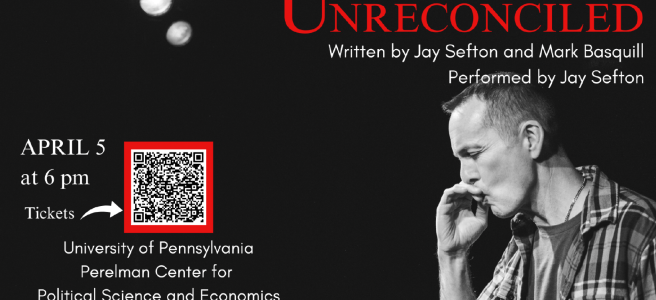
Child USA hosts a gripping one-man play at the University of Pennsylvania’s Perelman Center. Based on true events, actor-playwright Jay Sefton’s “Unreconciled” takes place in the Philadelphia Archdiocese. The story centers on a boy cast as Jesus in a school play directed by the parish priest.
What unfolds is a profound exploration of child sex abuse, resilience, and the challenging path toward healing. As the protagonist navigates through the Church’s victims’ reparations program, he discovers the transformative power of speaking his truth.
Sefton masterfully weaves unexpected humor into this poignant narrative, and the performance resonates with authenticity and emotional depth. He delves deep into themes of family and identity, exploring the complex meaning of reconciliation.
Don’t miss this powerful theatrical experience.
$40.00 suggested donation.
Details:
Saturday, April 5, 2025 at 6 pm
Location: University of Pennsylvania
Perelman Center for Political Science and Economics
lower-level auditorium
133 S. 36th Street
Philadelphia, PA 19104
 Catholics4Change
Please remove me from your email list. I left the Catholic Church during the pandemic and expressed my disdain for their support for President Trump at that time. I no longer want to know what is going on in the Catholic Church. Thanks
>
Becky,
I will remove you from our list now, and I can certainly understand your position. Kathy and I wish you the best.
Susan
I want to direct this response to Susan and Becky. It consists of two parts: one outlines the church’s stance on Trump, while the other presents the option available to Catholics if they feel the clergy has exceeded their authority.The Vatican’s Position on President Trump
The official stance of the Vatican toward former U.S. President Donald Trump has remained neutral, as the Church maintains its commitment to the separation of church and state and does not endorse political candidates. However, Pope Francis has spoken out on policies central to Trump’s administration, particularly those concerning immigration, social justice, and moral leadership.
Unofficially, Pope Francis has been critical of Trump’s policies and character, most notably condemning his stance on immigration. In a 2025 letter to U.S. Catholic bishops, the Pope denounced mass deportations, stating that such policies “damage the dignity of many men and women” and warned that governance based solely on force “will end badly.” (Reuters)
During the 2024 election, Pope Francis encouraged Catholics to vote according to conscience, describing the choice between Trump and his opponent as selecting the “lesser of two evils.” He criticized Trump’s hardline immigration policies as a “grave sin” while also condemning his opponent’s support for abortion rights as “assassination.” (Reuters)
While individual bishops and clergy have expressed varying opinions, the Vatican itself has not issued an endorsement of Trump, and Pope Francis’s comments indicate a strong moral concern about his leadership and policies.Subject: Responsibility of Catholics in Addressing Church Leadership
To those who feel disillusioned by the Church’s direction, it is understandable to be frustrated when clergy appear to stray from Vatican teachings or endorse positions that contradict the Pope’s guidance. However, it is the responsibility of every Catholic to understand the relationship between the Vatican and dioceses and to actively hold clergy accountable when their actions contradict Canon Law and official Church doctrine.
The Church is decentralized, meaning that individual bishops and priests have significant authority in their dioceses (Canon 381 §1). However, this authority is not unlimited. Canon 287 §2 specifically instructs clergy to refrain from political partisanship, and Canon 753 makes it clear that while bishops have teaching authority, they must remain in communion with the Pope and the Magisterium.
When clergy deviate from these principles:
Catholics have the duty to engage them directly—asking them to clarify their position in light of Vatican doctrine and Canon Law.
If they refuse to align with the Church’s official stance, it is our duty to report the matter to higher Church authorities:
The local bishop, who oversees the diocese.
If the issue is not resolved, the Apostolic Nuncio (the Pope’s representative in the country).
As a last resort, Rome itself through the Congregation for Bishops or the Dicastery for the Doctrine of the Faith.
As Catholics, our allegiance is to God, not to flawed human institutions. The Church should be a vehicle for faith, not a barrier. Silence and disengagement have allowed the Church to reach this point of crisis. If it is to be restored, it is the laity who must stand up and demand accountability, rather than simply walking away.
For those who have left the Church, their frustration is valid—but abandoning faith entirely is not the answer. The Church belongs to its faithful, and reclaiming it from those who distort its mission is a moral responsibility, not just an option.
Fred, I love what you wrote. “As Catholics, our allegiance is to God, not to flawed human institutions.” I believe that this is true for everyone, not just Catholics. All human institutions are inherently flawed. Some more than others. The differentiation lies within who has the power, knowledge, and willingness to address flaws within any institution. The Catholic Church hierarchy (from Bishops to Popes) has clarified its position through continued criminal action and inaction regarding clergy child sex abuse. If laity outcry is ineffective on such a clear matter, why should any Catholic claim a monkey at the circus and go through the process you shared? I don’t have to agree with Becky to understand her decision. It may have been the final straw that broke the framework of her Catholic faith. It’s what Kathy and I hoped to prevent with this site. Community helps support and activate faith even when the institutional Church fails us and our beliefs.
Thank you for your thoughtful comment. I truly appreciate your reflection, especially your recognition that “all human institutions are inherently flawed.” That’s something we can all agree on—and yet, it’s also why I believe we must engage rather than retreat, especially when those flaws deeply wound the very communities we care about.
You’re right that some failures, like the Church’s handling of clergy abuse, feel insurmountable. They shake the very foundation of trust. When outrage and sorrow seem to fall on deaf ears, it’s understandable why people walk away. And yet, sometimes what begins as a ripple becomes a wave of change—if it is fueled by earnest, consistent, and courageous action.
History shows us this. Take, for example, the War of 1812: a small, outgunned, and outnumbered group of people—First Nations, British subjects, immigrants, Québécois, Métis, a few Regulars and Fencibles, and even some American expatriates—banded together against repeated invasion attempts. Eleven times they were tested, and yet they stood their ground. Against all odds, they prevailed—not because of hierarchy, but because of unity, purpose, and resolve.
Today, we face another kind of challenge. If America continues down the path shaped by Trump’s influence, it risks losing its classification as a democratic nation. And yet too many people remain silent. Few write to Secretaries of State, or their representatives. Few organize. But the mechanisms for change still exist—letters, protests, votes, and conversations like this one. The question isn’t just whether they’ll work. The question is whether we’ll use them. If we don’t act, what do we have left?
https://www.cbc.ca/news/world/trump-democracy-report-1.7486317
I’ve seen the power of faithful, organized laypeople. I witnessed a parish community, Gurnee, Illinois, deeply dissatisfied with their priest, come together and advocate for change. And they succeeded. The priest was replaced. The diocese listened. It’s not easy—but it can be done.
So no, we’re not powerless. And yes, sometimes the institution fails us. But that’s when community matters most—because it’s us, not the hierarchy, who carry the soul of the Church forward. And maybe, just maybe, our ripples will one day become the turning tide someone else is waiting for.
https://www.bishop-accountability.org/reports/2005_09_21_Philly_GrandJury/Philly_05_23_TJSmith.pdf
Let’s get back to the subject of the post